

Data warehouse vs data lake vs lakehouse: quick explanation:
- A data warehouse stores structured, processed data optimized for business intelligence and reporting
- A data lake stores large volumes of raw structured and unstructured data for flexible analytics and machine learning
- A data lakehouse combines both approaches by enabling analytics directly on data lake storage while adding governance, schema management, and high-performance querying.
When designing a company’s data management strategy, one of the first decisions is how and where to store data. Traditionally, organizations chose between a data warehouse for structured, curated data or a data lake for storing large volumes of raw data.
Today, that decision is no longer just about storage. The rise of AI is fundamentally changing how data platforms are designed. Modern architectures must support not only reporting and dashboards, but also real-time data processing, unstructured data, and AI-driven applications.
As a result, many organizations are moving toward data lakehouse architectures, which combine the flexibility of data lakes with the performance and governance of data warehouses — while also supporting modern AI workloads.
In this article, you’ll find:
- Comparison: Data warehouse vs. data lake vs. lakehouse at a glance
- What is a data warehouse?
- What is a data lake?
- What is a data lakehouse?
- Modern data architectures: beyond storage
- How AI is changing data architectures
- Which architecture should your organization choose?
- How data warehouses and lakes fit into the modern data stack
- How KNIME supports ETL and ELT processes
- Setting up your modern data platform
- Data warehouse vs. data lake vs. data lakehouse FAQs
Comparison: Data warehouse vs. data lake vs. lakehouse at a glance
| Feature | Data warehouse | Data lake | Data lakehouse |
| Data format | Structured and processed | Raw, native format (structured, semi-structured, unstructured) | Supports both raw and structured |
| Flexibility | Less flexible; designed for specific data types | Highly flexible; supports various data types | Highly flexible, supports various data types |
| Setup costs in terms of time and effort | High upfront effort (schema design, ETL), faster downstream | Low upfront effort, higher downstream processing cost | Moderate: less upfront than warehouse, more structure than lake; balances effort across lifecycle |
| Storage | Database systems | Object storage | Object storage with transactional layer |
| Query performance | Fast for BI and SQL analytics | Variable; often slower without optimization | Fast: near-warehouse performance with optimizations (caching, indexing, metadata layers) |
| Governance | Strong governance and data quality controls | Often lacks robust governance; risk of data swamps | Strong governance |
| Metadata repository | Rich metadata: Includes metadata for data structure and lineage | Basic metadata: Includes metadata for data organization (file-level, catalogs) | Advanced metadata (schema, lineage, versioning, time travel) |
| User accessibility | Some technical skills required to write specific queries and navigate the structure to extract the data, but it’s easier to use since the data is already pre-processed. | It's easy to extract data in its raw form, but you’ll need to handle data cleaning and preprocessing before gaining insights. | Broad accessibility: SQL + data science + machine learning workloads |
| Performance | Optimized for fast, complex queries | Variable performance; optimization needed | High performance with optimized storage formats + query engines |
| Best for | BI and reporting | Data science, ML, and large-scale ingestion | Unified analytics and AI |
What is a data warehouse?
A data warehouse is a centralized analytics database that stores cleaned, structured data and is optimized for reporting and business intelligence.
You can think of a data warehouse as a well-organized library where the data has already been cleaned, structured, and categorized so it can be quickly queried and analyzed.
Data warehouses (DWH) are designed to handle large volumes of data quickly, so when someone asks a question, such as "How many product returns did we have last month?", they receive an answer quickly.
A DWH typically includes a metadata repository, which provides essential information about the data structure, including schema details and relationships, such as detailing the organization of tables, columns, data types, relationships, and constraints. A metadata repository also tracks data lineage by providing insights into the data's origin, transformations, and movements throughout the data pipeline to ensure quality, transparency, and compliance. This helps users understand and navigate the data.
A data warehouse can return answers to queries quickly because the data has already been prepared for analysis.
Modern cloud data warehouses include platforms such as:
- Snowflake
- Google BigQuery
- Amazon Redshift
- Azure Synapse
Key features of a data warehouse
Here are the key features of a data warehouse:
- Central repository. A DWH serves all departments within a company and is designed to streamline data querying. Since the data is already pre-processed and aggregated, queries are quicker and easier to perform, making it ideal for reporting and analysis. It serves as the main hub for analytics and reporting.
- Integrate multiple data sources: A DWH can store a diverse set of aggregated data from multiple sources, such as:
- transactional databases
- log files
- CRM systems
- ERP systems
- web services
- data lakes, and other data sources.
- Historical data. A key role of data engineering is to collect data over time. While many data sources only provide current data (e.g., daily, hourly, weekly), data warehouses include historical data and make it available to end users.
- Integrated data. Data is organized using predefined schemas optimized for analytical queries. It is structured and organized for user-friendly access. For example, contracts from a CRM system could be processed to provide several aggregated measures that better describe the customer’s habits and values. Similarly, data on medical visits can be transformed into healthcare KPIs to illustrate patient health and progress.
- Subject-oriented: DWHs focus on specific subjects, such as sales, customers, and patients, and aggregate data for specific tasks.
- Time-variant: Data in a DWH is periodically updated to reflect changes over time.
- Non-volatile: Once the data is stored in a DWH, it cannot be updated or deleted during transactional processing, which is essential for preventing data loss.
How to build a data warehouse
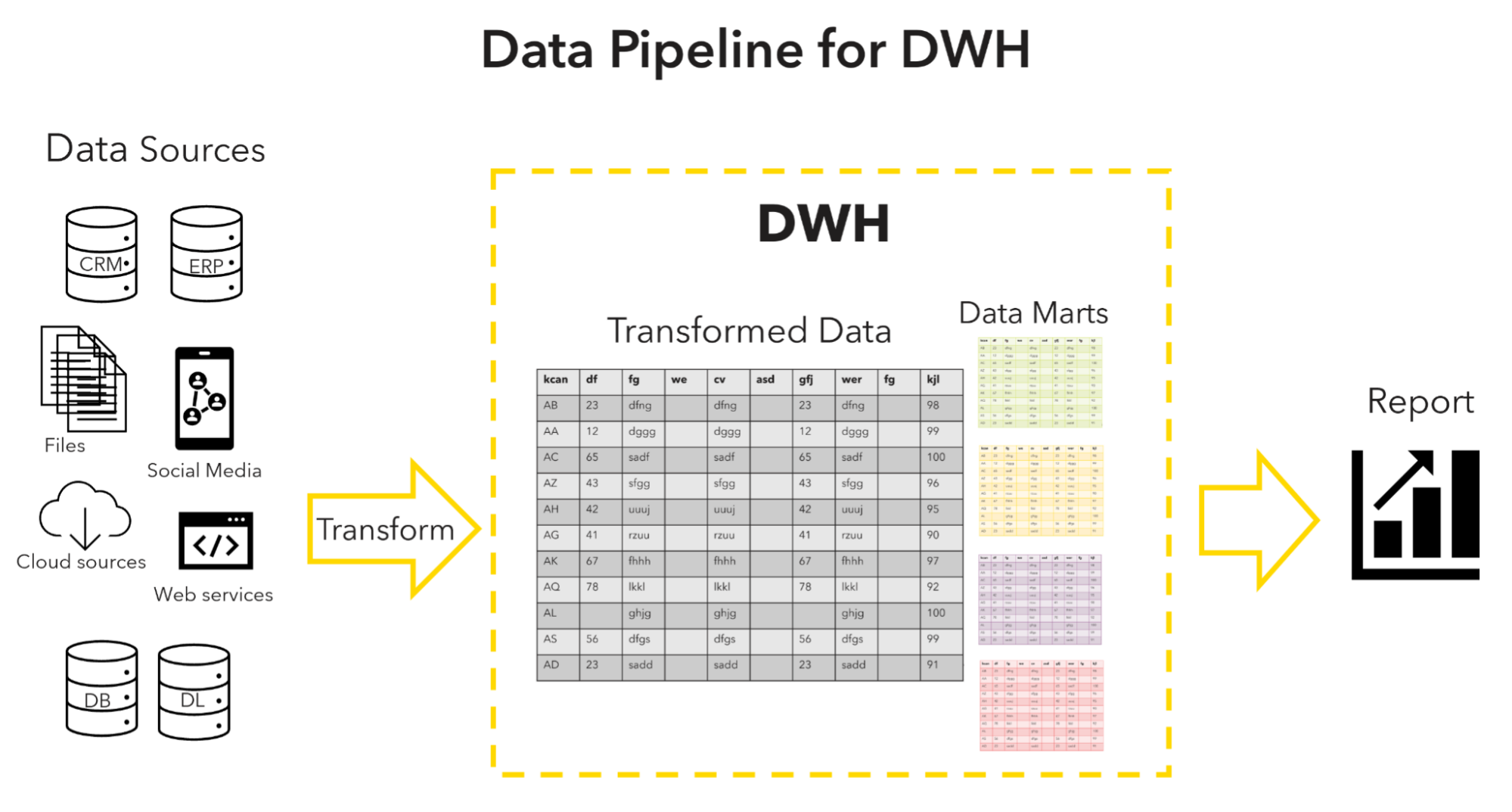
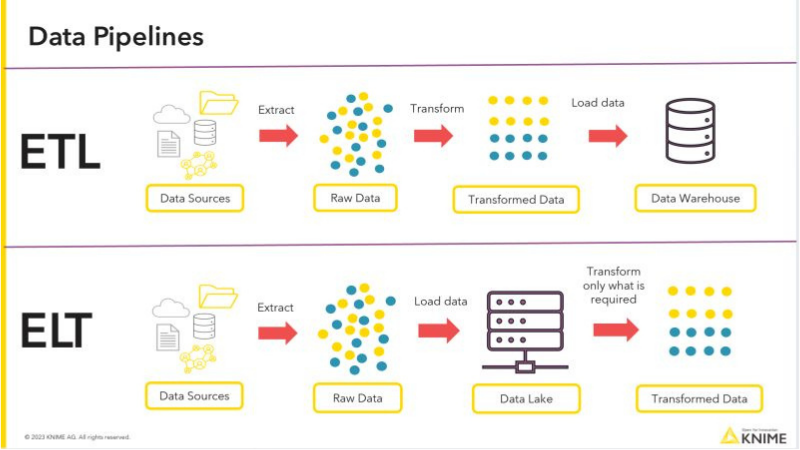
To build a DWH, data is retrieved from various sources, transformed to create relevant business metrics, and then loaded into the DWH. Historically, this used ETL (Extract, Transform, Load):
- Extract data from systems
- Transform and clean the data
- Load it into the warehouse
Today, many cloud warehouses also support ELT, where data is loaded first and transformed using the warehouse’s compute engine.
Within a warehouse, smaller subsets of data are stored in small reserved tables, called Data Marts. Data marts are often created for specific business areas such as:
- Sales
- Marketing
- Finance
- Customer analytics, and more.
For data storage, a variety of commercial solutions can be used including SQL, no-SQL, cloud-based, and on-premise options, each of which operates on different schemas.
The benefits of data warehouses
The primary advantage of Data Warehouses is the availability of ready-to-use analytical data. It is structured and aggregated data and provides a higher-level view of the business, organization, or research process.
Because the data has already been cleaned, modeled, and structured, analysts can quickly build reports and dashboards.
However, designing a warehouse requires significant data preparation and data engineering efforts to store all data in an immediately consumable format. Companies must weigh the tradeoff between easily accessible, informative data and the investment needed to design and implement the data architecture, a decision often informed by data engineers and shared across departments.
The DWH approach is particularly beneficial for companies with repetitive data operations across different departments.
As an example, if several departments require regular reports based on customer loyalty KPIs, it would be time-efficient to store and update the KPI once in the DWH rather than recalculating it every time for each report across all departments.
What is a data lake?
A data lake (DL) is a scalable storage system that holds raw structured and unstructured data in its original format and from various data sources.
A data lake can store virtually any type of data, including:
- structured data from relational databases
- semi-structured data like CSV files or XML/JSON objects
- unstructured data such as emails, documents, or PDF files; and
- binary data such as images, audio, and video.
For data storage, various commercial solutions are available, both cloud-based and on-prem. A data catalog is used in both DLs and DWHs to provide information about data storage locations and how data is organized. This includes a metadata repository that helps users understand what information is in the data lake or data warehouse.
Unlike warehouses, data lakes are designed to store massive volumes of data cheaply, often using scalable object storage systems such as:
- Amazon S3
- Azure Data Lake Storage
- Google Cloud Storage
How data lakes work
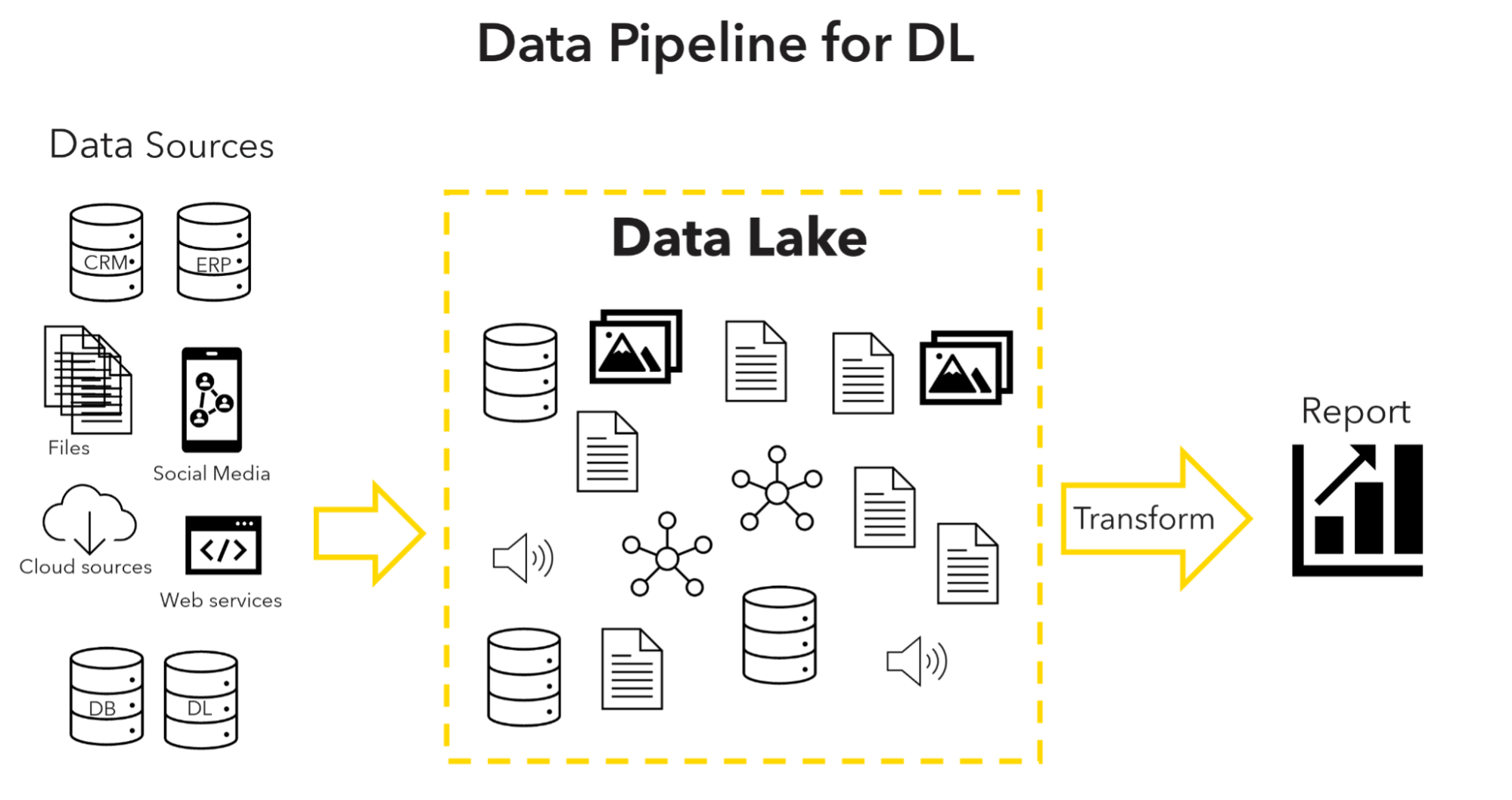
In a data lake architecture, data is typically loaded directly into storage and is referred to as ELT (Extract, Load, Transform), as the loading occurs before the transformation
- The data pipeline for a data lake starts by ingesting data from the various data sources directly into the data storage in its raw format.
- The end user then extracts this data, transforms it into the desired format, and visualizes it in reports.
Key features of a data lake
Here are the key features of a data lake:
- Central repository: A DL can ingest data in its original form, allowing for the storage of:
- structured data from relational databases
- semi-structured data like CSV files and JSON objects
- unstructured data, such as emails and documents
- binary data including images and audio files.
- Storage solutions: Data lakes can be implemented using various commercial solutions, available both on-premise and in the cloud. Its open formats prevent lock-in to restricted systems like a data warehouse.
- Data catalog: A DL uses a data catalog to help users understand where data is stored and how it is organized. It includes a metadata repository that provides essential information about the data. It also helps to eliminate data silos, allowing users to easily access and catalog all data sources.
- Resource-effective: DL leverages object storage which is inherently scalable and designed to handle vast amounts of data.
The benefits of data lakes
The main advantage of a DL is its flexibility. Organizations can store raw data quickly from various sources without the need for preprocessing or predefined schemas.
This eliminates the requirement of complex data architecture and data preparation, resulting in lower upfront costs compared to a DWH.
However, when creating reports, all KPIs, metrics, and aggregated quantities must be recalculated from scratch, which can be time-consuming when considering the workload across all departments.
Note that if data lakes are not properly managed, they can become "data swamps", making it difficult to find the necessary data you need amid vast amounts of uncurated raw data.
The data lake approach is often recommended for companies that:
- have yet to define their data strategy
- lack the resources to process their data efficiently, or
- need to quickly collect large volumes of data without worrying about structure.
For example, in IoT applications, large amounts of fast unstructured data are collected from a wide range of sources. The rapid influx of this data makes it difficult to use traditional DWH.
What is a data lakehouse
A data lakehouse is a data architecture that combines data lake storage with warehouse-style data management and performance.
It combines the flexibility of data lakes with the performance and governance of data warehouses.
Lakehouses store data in open formats on object storage while adding layers that enable:
- ACID transactions
- schema enforcement
- indexing and performance optimization
- versioning and time travel
This allows analytics workloads to run directly on data lake storage without duplicating data into a warehouse.
Popular lakehouse technologies include:
- Databricks Lakehouse
- Delta Lake
- Apache Iceberg
- Apache Hudi
Many modern cloud platforms also support lakehouse-style architectures.
Why lakehouses are gaining popularity
Many organizations previously maintained separate data lakes and data warehouses, which created duplicate data and complex pipelines.
Lakehouses simplify the architecture by enabling both BI analytics and machine learning on the same storage layer.
This architecture supports:
- batch analytics
- streaming data pipelines
- AI and ML workloads
- large-scale data exploration
Modern data architectures: beyond storage
Modern data platforms often extend beyond storage systems.
Organizations increasingly combine warehouses, lakes, and lakehouses with additional architectural concepts.
Streaming data pipelines
Many modern systems process data in real time using technologies such as:
- Apache Kafka
- Spark Streaming
- Flink
This enables real-time dashboards and event-driven analytics.
Data mesh
Data mesh is an organizational approach where domain teams manage their own data products instead of relying on a centralized data team.
Key principles include:
- decentralized data ownership
- domain-oriented data products
- self-service data infrastructure
- strong governance standards
Semantic layers
Many modern platforms also use a semantic or metrics layer to define business metrics centrally, ensuring consistent KPIs across dashboards and analytics tools.
These architectural patterns are also being shaped by one of the biggest shifts in data today: the rise of artificial intelligence.
How AI is changing data architectures
Artificial intelligence is reshaping data architectures from systems designed for reporting into platforms built for real-time, intelligent applications.AI is driving three key shifts:
1. From BI platforms to AI-ready data platforms: Traditional architectures optimized for dashboards and reporting are evolving to support machine learning, feature engineering, and real-time predictions. This is accelerating the adoption of lakehouse architectures, which unify analytics and AI workloads on the same data.
2. From structured to multi-modal data: AI relies heavily on unstructured data such as text, images, audio, and logs. As a result, organizations are moving beyond warehouse-only architectures toward data lakes and lakehouses that can handle diverse data types at scale.
3. From batch to real-time data processing: AI-powered use cases, such as recommendations, fraud detection, and predictive maintenance, require low-latency, streaming data pipelines, not just batch processing.
New components in modern data architectures
AI introduces new layers to the data stack:
- Feature stores to manage and reuse machine learning features
- Vector databases to enable semantic search and retrieval-augmented generation (RAG)
- Advanced data governance to ensure data quality, lineage, and trust
Convergence of data and AI workflows
Data engineering, analytics, and machine learning are converging into unified platforms.
Instead of separate systems, organizations are building architectures where:
- data ingestion
- transformation
- analytics
- model training and serving
operate on the same foundation.
This convergence is a key reason why lakehouse architectures are becoming the default for modern data platforms.
What this means
Modern data architectures are no longer just about storing and analyzing data, but designed to power intelligent systems in real time.
Which architecture should your organization choose?
There is no universal answer. The best architecture depends on your company’s:
- Analytics needs
- Data strategy
- Maturity in data management
- Governance requirements
- AI and machine learning use cases
In practice, many organizations adopt a hybrid approach or lakehouse-based approach.
For example:
- a data warehouse for curated business metrics and reporting
- a data lake for raw ingestion and experimentation
- a lakehouse architecture that supports both analytics and AI workloads on the same platform
As AI becomes a core part of business operations, the decision is increasingly influenced by the need to:
- Handle unstructured data (text, images, logs)
- Support machine learning and AI pipelines
- Enable real-time or near real-time data processing
Rather than choosing one system exclusively, modern data platforms often focus on which data should be curated for fast analytics and which should remain flexible for exploration.
When should you use a data warehouse vs. data lake vs data lakehouse?
Use a data warehouse if:
- Your main goal is BI dashboards
- You need consistent business metrics
- Most users are analysts working with structured data
- AI use cases are limited or rely on already processed data
Use a data lake if:
- You ingest large volumes of raw data
- You run machine learning models
- Your data schemas evolve frequently
- You need flexibility before defining how data will be used
Use a data lakehouse if:
- You want a unified platform for analytics and AI
- Your team runs both BI and ML workloads
- You want to reduce data duplication
- You require real-time or near-real-time data processing
As AI adoption grows, many organizations are choosing lakehouse architectures to support both traditional analytics and modern AI workloads on a single platform.
How data warehouses and lakes fit into the modern data stack
A modern data platform often includes:
- ingestion tools
- object storage
- a lakehouse or warehouse
- transformation tools
- semantic layers
- BI tools
- machine learning platforms
Tools like KNIME help organizations build and orchestrate data pipelines across data warehouses, data lakes, and lakehouse environments.
How KNIME supports ETL and ELT processes
KNIME is a platform for accessing, blending, analyzing, and visualizing data without coding.
KNIME provides a visual interface for building data pipelines that support both ETL and ELT architectures.
With KNIME, you can easily:
- Connect to all types of data sources
- Assemble automated data pipelines for both ETL and ELT processes
- Integrate with cloud data warehouses and data lakes
- Implement the necessary metrics for your business requirements.
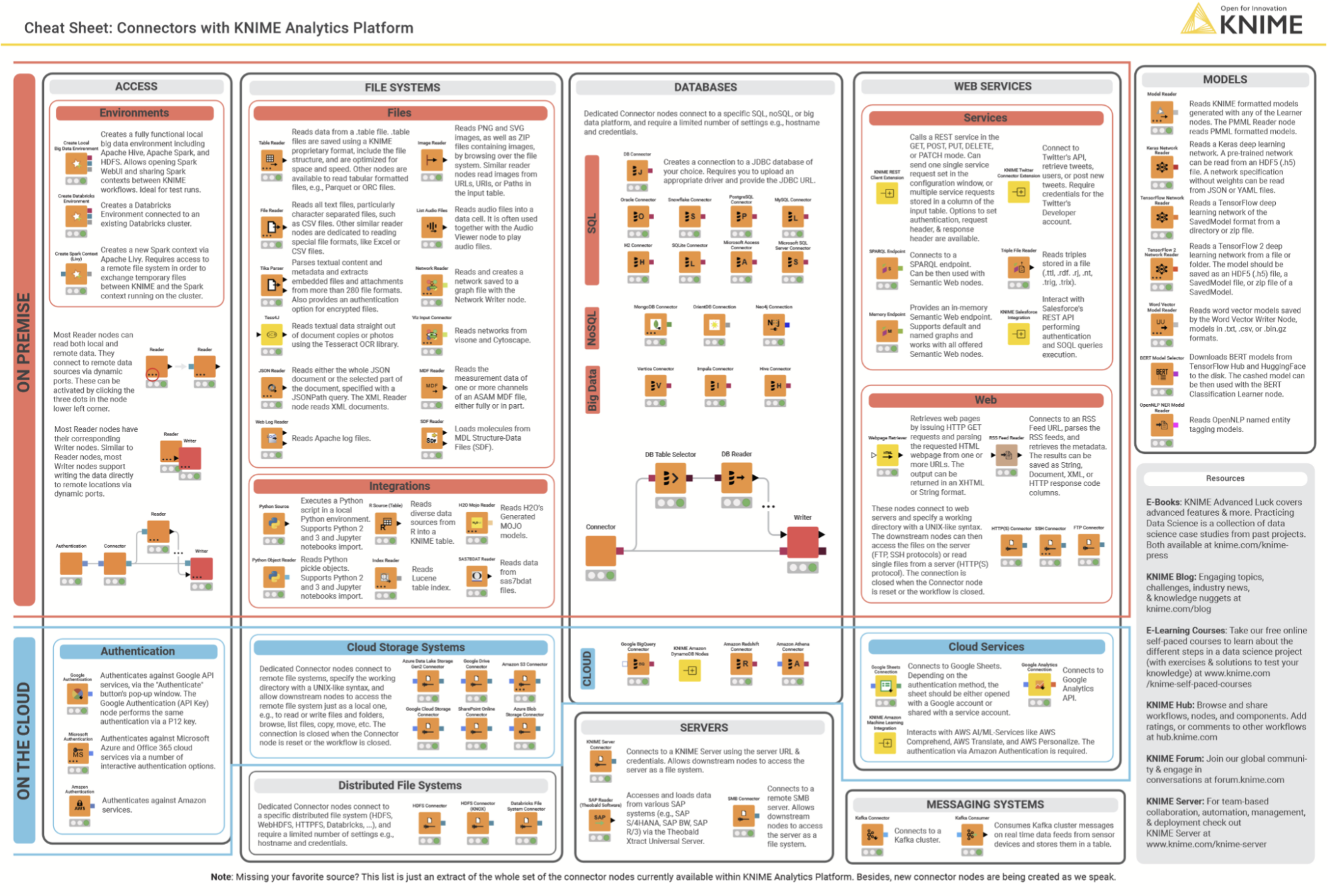
KNIME offers 300+ connectors for interacting with:
- SQL databases
- NoSQL systems
- Cloud storage
- Big data platforms
- Web services, and more.
For more detailed information, check the KNIME Connectors cheat sheet. Watch the video Connectors with KNIME for more information about the 300+ available KNIME Connectors.
This flexibility with KNIME means you can work seamlessly with data warehouses, data lakes, and lakehouse platforms.
Setting up your modern data platform
In this article, we explored the differences between data warehouses, data lakes, and lakehouses.
While data warehouses remain essential for structured analytics, data lakes offer flexibility for large-scale data storage. Modern lakehouse architectures increasingly combine both approaches, enabling organizations to run analytics and AI workloads on the same data platform.
Choosing the right architecture depends on your organization’s data strategy, infrastructure, and analytical needs.
To learn more about building scalable data pipelines, explore the data engineering learning path in the KNIME Learning Center, which covers topics from data literacy to production-grade data workflows — all using visual programming.
Data warehouse vs. data lake vs. data lakehouse FAQs
Here are answers to some of the most frequently asked questions about data warehouses and data lakes:
Can a data lake be a data warehouse?
No, data lakes and data warehouses can co-exist but are fundamentally different. Data lakes store unprocessed data, whereas data warehouses store pre-processed data. You can decide whether you have a data lake, a data warehouse, or a mixture of the two based on this difference.
Are data lakes faster than data warehouses?
They are designed to meet different requirements.
- Data warehouses are optimized for fast querying and reporting. The data here is already processed and cleaned, which means that querying data is easier and faster. Note, however, that entering data into the data warehouse takes longer because it has to be processed before it is entered.
- Data lakes are designed to enable a business to store higher volumes of data. The data is stored in its raw format until a team decides to process and transform it for analysis. This means that entering the data is easy, but retrieving the data can be more time-consuming.
What is a data mart?
A data mart is a smaller subset of a data warehouse tailored for a specific department or business function, such as marketing or finance.
What’s the difference between a data warehouse and a data mart?
A data warehouse is a large, central repository that stores data from various sources across an entire organization. It is designed to support many departments and processes – or even the whole organization.
A data mart is a smaller, more focused subset of a data warehouse, tailored to meet the needs of a specific department or business function, like marketing or sales.
What are data warehouse layers?
Data warehouse layers are stages in the data processing pipeline. Data warehouse layers include the data source layer for collecting raw data, the staging layer for temporary storage, the ETL layer for transforming data, the storage layer for structured data storage, the access layer for querying and reporting, and the metadata layer for managing and monitoring data.